1
/
of
1
Hewlett Packard Enterprise
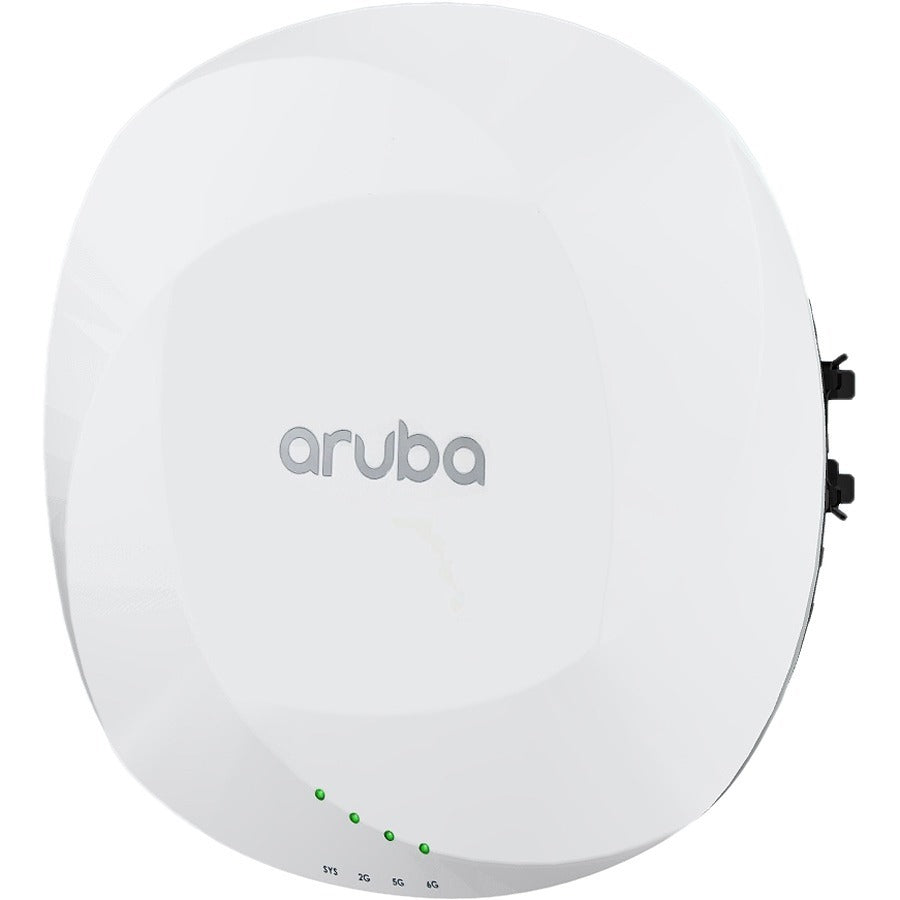
HPE AP-615 Tri Band 802.11ax 3.60 Gbit/s Wireless Access Point - Indoor - TAA Compliant
HPE AP-615 Tri Band 802.11ax 3.60 Gbit/s Wireless Access Point - Indoor - TAA Compliant
SKU:R7J55A
Regular price
$1,137.99 USD
Regular price
Sale price
$1,137.99 USD
19 in stock
Quantity
Couldn't load pickup availability
HPE AP-615 Tri Band 802.11ax 3.60 Gbit/s Wireless Access Point - Indoor - TAA Compliant
For enterprises who need more wireless capacity and/or wider channels, Aruba 610 Series Campus APs are designed to take advantage of the newly available 6 GHz spectrum using a unique dual-radio/tri-band architecture. Adding support for the 6 GHz band to the traditional 2.4 GHz and 5 GHz bands more than doubles the available wireless capacity in a wireless network - so you can meet growing demand due to bandwidth-hungry video, increasing numbers of client and IoT devices, and growth in cloud.
Unique to Aruba, the 610 Series features two radios that can be tuned to any two of the three available spectrum bands for Wi-Fi (2.4 GHz, 5 GHz, 6 GHz). This flexibility provides a cost-effective and compact platform that delivers full tri-band coverage as part of a multi-AP deployment and can be used with software that will intelligently and flexibly configure the radios of each of these dual-radio APs.
More capacity and wider channels
The Aruba 610 Series APs are designed to take advantage of Wi-Fi 6E and the 6 GHz band, which translates into far greater speeds, wider channels for multi-gigabit traffic, and less interference. Its two 2x2 MIMO radios deliver a combined peak data rate of up to 3.6 Gbps when configured for concurrent 5 GHz and 6 GHz operation.
Advantages of 6 GHz
Wi-Fi 6E provides up to 1200 MHz of additional unlicensed spectrum in the 6 GHz band for higher throughput and improved application performance. With up to seven 160 MHz channels, Wi-Fi 6E can better support low-latency, bandwidth hungry applications like high-definition video and augmented reality/virtual reality applications. Only Wi-Fi 6E capable devices can use the 6 GHz band so there is no interference or slowdowns due to legacy devices.
Device class support
The Aruba 610 Series APs are part of the low power indoor (LPI) device class. This fixed indoor-only class uses lower power levels and does not require an Automated Frequency Coordination service (AFC) to manage incumbent outdoor services, which is required for standard class APs.
Global readiness
While the need for more Wi-Fi capacity is recognized across the globe, countries are approaching the 6 GHz band differently. The 610 Series APs are set up to automatically update regulatory rules once Wi-Fi 6E regulations have been approved and certified.
Extend the benefits of Wi-Fi 6
The Aruba 610 Series APs are based on the 802.11ax (Wi-Fi 6) standard, which means that all its efficiency and security enhancements are also available on the 6 GHz band. Wi-Fi 6 features such as Orthogonal Frequency Division Multiple Access (OFDMA), BSS coloring etc. are fully supported on the Aruba Wi-Fi 6E access points as well.
UPC: 190017493176
Unique to Aruba, the 610 Series features two radios that can be tuned to any two of the three available spectrum bands for Wi-Fi (2.4 GHz, 5 GHz, 6 GHz). This flexibility provides a cost-effective and compact platform that delivers full tri-band coverage as part of a multi-AP deployment and can be used with software that will intelligently and flexibly configure the radios of each of these dual-radio APs.
More capacity and wider channels
The Aruba 610 Series APs are designed to take advantage of Wi-Fi 6E and the 6 GHz band, which translates into far greater speeds, wider channels for multi-gigabit traffic, and less interference. Its two 2x2 MIMO radios deliver a combined peak data rate of up to 3.6 Gbps when configured for concurrent 5 GHz and 6 GHz operation.
Advantages of 6 GHz
Wi-Fi 6E provides up to 1200 MHz of additional unlicensed spectrum in the 6 GHz band for higher throughput and improved application performance. With up to seven 160 MHz channels, Wi-Fi 6E can better support low-latency, bandwidth hungry applications like high-definition video and augmented reality/virtual reality applications. Only Wi-Fi 6E capable devices can use the 6 GHz band so there is no interference or slowdowns due to legacy devices.
Device class support
The Aruba 610 Series APs are part of the low power indoor (LPI) device class. This fixed indoor-only class uses lower power levels and does not require an Automated Frequency Coordination service (AFC) to manage incumbent outdoor services, which is required for standard class APs.
Global readiness
While the need for more Wi-Fi capacity is recognized across the globe, countries are approaching the 6 GHz band differently. The 610 Series APs are set up to automatically update regulatory rules once Wi-Fi 6E regulations have been approved and certified.
Extend the benefits of Wi-Fi 6
The Aruba 610 Series APs are based on the 802.11ax (Wi-Fi 6) standard, which means that all its efficiency and security enhancements are also available on the 6 GHz band. Wi-Fi 6 features such as Orthogonal Frequency Division Multiple Access (OFDMA), BSS coloring etc. are fully supported on the Aruba Wi-Fi 6E access points as well.
- Wireless access point supports deployment of a reliable wireless network, helping enable stable data communication across business environments
- 802.11ax wireless LAN standard supports dependable communication, helping devices exchange data reliably
- 2.5 Gigabit Ethernet Ethernet technology supports wired connectivity, helping provide stable communication with connected network devices
- Ceiling Mountable form factor supports convenient handling, helping improve placement reliability
- 3.60 Gbit/s wireless transmission speed supports fast data exchange, helping maintain reliable wireless communication
- Internal antenna form factor supports consistent signal delivery, helping maintain reliable wireless connectivity
- Data Encryption helps protect transmitted and stored information on the network, supporting safer wireless communication
- Management port supports structured network control, helping enable scalable deployment across larger wireless installations
- PoE PD port supports receiving power directly from a PoE sour
Share